
Maximizing Earnings with Tracknow: Navigating Automated Affiliate Payout Tiers by Achieving Goals
In the ever-evolving landscape of affiliate marketing, Tracknow distinguishes itself with a unique approach to automated payouts. This article delves into how Tracknow's system encourages affiliates by tying payouts to the attainment of specific objectives, offering a tiered structure that both incentivizes performance and boosts potential earnings. For instance, when an affiliate achieves milestones such as 'X' sales, 'Y' conversions, or a particular volume of business, they are seamlessly transitioned to the next tier, gaining access to higher commission rates and more advantages. Additionally, reaching set targets like a specific number of quality leads or achieving a defined customer retention rate can also prompt a move to a higher tier, spurring affiliates towards sustained growth and achievement.


Flat affiliate commissions are easy to launch, but they do not always give high-performing partners a reason to keep growing. If an affiliate earns the same rate after five approved sales as they do after fifty, the program may be leaving both revenue and partner motivation on the table.
Automated affiliate commission tiers connect better commission terms to measurable performance. Instead of reviewing every affiliate manually, a program defines the metric, qualifying statuses, thresholds, commission rates and evaluation period in advance. The system can then move eligible affiliates to the appropriate level when they reach the required result.
Tracknow’s Payout Automation tool is designed for this type of performance-based structure. It can evaluate affiliates using metrics such as conversion count, conversion amount, transaction volume, first-time deposits (FTDs), earned commission or lifetime connections. Program managers can also decide whether a tier is permanent, resets during the current month or year, or is determined by performance in the previous month or year.
This guide explains how automated tiers work, how they differ from bonuses and goal-based payouts, how to choose meaningful thresholds and how to reward stronger performance without sacrificing program margins.
What Are Automated Affiliate Commission Tiers?
An affiliate commission tier is a payout level linked to a defined performance threshold. A new affiliate starts with the program’s standard commission. After reaching a target, that affiliate becomes eligible for a higher rate on qualifying future activity.
A simple ecommerce structure could look like this:
- Tier 1: 5% commission for 0–4 approved sales
- Tier 2: 7% commission after 5 approved sales
- Tier 3: 9% commission after 10 approved sales
- Tier 4: 12% commission after 15 approved sales
The tier names are less important than the rule behind each transition. The system needs a reliable event, an unambiguous threshold, qualifying statuses and a clear timeframe. Once these are defined, advancement no longer depends on a manager checking reports and changing individual commission settings by hand.
Commission Tiers, Goal-Based Payouts, Bonuses and Payments Are Not the Same
The word “payout” is often used for several different processes. Separating them prevents confusing program rules and misleading affiliate communication.
| Rule | What triggers it | What changes |
|---|---|---|
| Commission tier | An affiliate reaches a performance threshold | The commission applied to eligible future activity |
| Goal-based payout | A conversion arrives with a specific goal value | The rule used for that event or conversion type |
| Performance bonus | An affiliate reaches a target | A one-time or recurring bonus is awarded; the base rate can remain unchanged |
| Affiliate payment | Approved commission becomes payable under the program’s payment policy | Money is sent or prepared for transfer to the affiliate |
For example, a store may use commission tiers to increase an affiliate’s standard rate from 5% to 8% after 30 approved sales. Separately, it may use a goal-based payout to pay 10% whenever a tracked purchase belongs to a selected product category. These rules are compatible, but they solve different problems.
Likewise, calculating a commission automatically does not necessarily mean that money is transferred immediately. Validation periods, refunds, payment thresholds, invoices, tax requirements and the selected payment method can still determine when the affiliate is paid. Our guide to affiliate commission and payment models explains the differences between CPS, CPA, CPC, recurring commissions, revenue share and other structures.
How Tracknow’s Tier Automation Works
Tracknow separates commission settings from the automation that assigns affiliates to them. This gives the program control over both the economic terms and the rules for advancement.
- Create the base payout. This is usually a General Payout available to all eligible affiliates in the campaign.
- Create each higher-tier payout. Higher levels can be configured as Personal Payouts so they are not generally available before an affiliate qualifies.
- Select the automation metric. Choose the performance value the system should measure.
- Add tier thresholds. Connect each target to the payout that should become active when the target is reached.
- Choose the timeframe. Decide whether performance is cumulative, resets during the current period or determines the affiliate’s level for the following period.
- Filter qualifying statuses. The automation can count only conversions with selected statuses, such as approved conversions.
After the automation is created, affiliates can see their current tier and progress toward the next level in their portal. This visibility matters: a commission ladder is much more motivating when a partner knows the target, the reward and how close they are to reaching it.
Reliable Attribution Must Come Before Automation
A tier system can only be as fair as the data feeding it. Before launch, define the attribution window, duplicate-conversion rules, qualifying statuses, refund handling and the event that represents a successful result. If different campaigns credit the same customer differently, affiliates may appear to reach tiers for reasons unrelated to their actual contribution.
This is especially important when a customer interacts with several partners or channels. Decide whether one partner receives full credit or whether the program uses a broader multi-touch attribution model. The decision should be documented before performance thresholds are published.
The tracking method also needs to capture the selected metric reliably. Cookies and tracking links may be sufficient for some programs, while financial, subscription or high-value campaigns may depend on server-to-server and postback tracking. For a broader comparison, see the guide to affiliate tracking methods.
Which Performance Metric Should You Use?
The best metric is the one that reflects real business value and can be reported consistently. Tracknow supports several automation types.
Conversion Count
This is the clearest option when eligible actions have relatively similar value. It can work well for approved ecommerce orders, subscriptions, qualified leads or completed sales. It is easy for affiliates to understand, but it can reward quantity over quality if low-value and high-value conversions are counted equally.
Conversion Amount
Amount-based tiers reward the total monetary value attributed to an affiliate. They are useful when order sizes vary significantly. A partner generating ten large purchases may deserve a higher tier than one generating twenty very small purchases, even though the second partner has more conversions.
Transaction Volume
Volume is especially relevant to financial programs where referred clients generate measurable trading activity. It lets a broker reward partners for active client value rather than registration volume alone.
First-Time Deposits
FTD-based progression can be used in broker and iGaming programs. Because a registration is not the same as a funded customer, FTDs can provide a stronger acquisition-quality signal. The exact qualification rules—including minimum deposit requirements and approved status—should be documented clearly.
Commission Generated
This metric bases advancement on the amount of commission an affiliate has already earned. It can normalize performance across several conversion or payout types, although managers should model the feedback loop carefully: a higher tier may increase commission generation and make the next threshold easier to reach.
Lifetime Connections
Programs using Tracknow’s lifetime functionality can base progression on the number of clients connected to an affiliate. This may be useful when the commercial relationship extends beyond one conversion and the program wants to reward affiliates for building a lasting client base.
Choosing the Right Evaluation Period
A tier threshold has little meaning without a timeframe. “Reach 20 approved sales” could mean this month, last month, this year or across the affiliate’s entire history. Each interpretation creates different partner behavior.
- All Time: historical performance is cumulative. Affiliates can move up without a scheduled reset.
- This Month: performance is evaluated during the current month. Affiliates can advance as they hit thresholds, then reset at the start of the next month.
- Last Month: the previous month’s performance determines the tier used for the entire current month.
- This Year: affiliates can advance during the current year and reset when the next year begins.
- Last Year: performance in the previous year determines the tier for the current year.
Use an all-time model when the higher commission is intended to recognize long-term status or loyalty. Use a current-period model for short performance cycles and active competition. A previous-period model is often easier to budget because the affiliate’s commission rate remains stable throughout the new period.
A Practical Tier Example
Suppose an online retailer wants to reward sales volume while protecting itself from cancelled orders. It creates four payouts:
- Tier 1: 5% commission
- Tier 2: 7% commission after 5 approved conversions
- Tier 3: 9% commission after 10 approved conversions
- Tier 4: 12% commission after 15 approved conversions
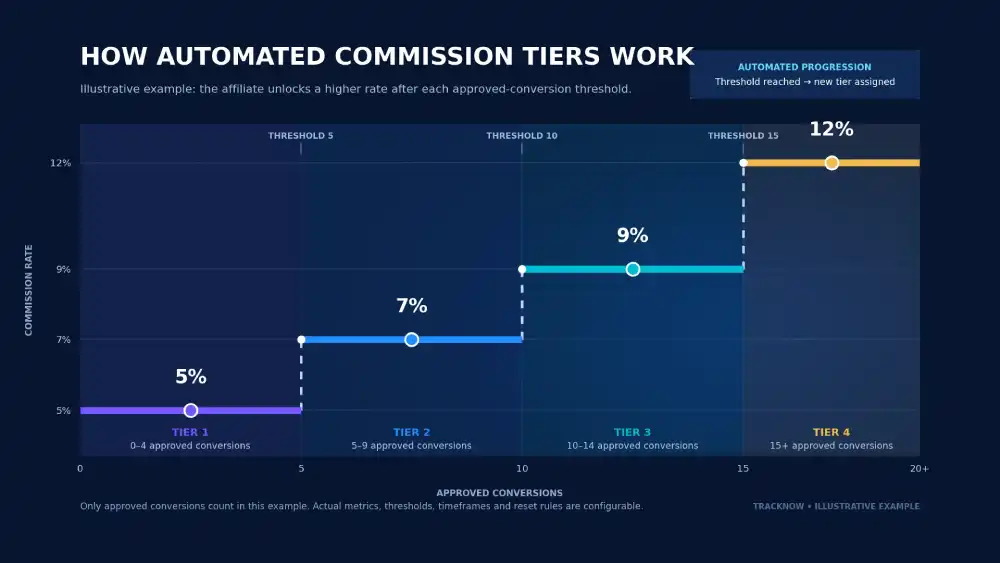
The retailer selects Conversions as the automation type and includes only Approved conversions in the calculation. If it chooses All Time, an affiliate who reaches Tier 3 retains that level and can continue progressing. If it chooses This Month, the affiliate advances during the month but begins the next month again at the initial tier.
This distinction should be explained before launch. Otherwise, an affiliate may assume that a hard-earned rate is permanent when the program intended it to reset every month.
How to Check Whether Every Tier Is Profitable
A higher commission is useful only when the additional affiliate activity still produces an acceptable contribution margin. Before publishing the ladder, model every level with realistic order values, approval rates, refunds and variable costs.
For a percentage-based CPS program, a simple ceiling can be estimated as follows:
Maximum sustainable commission rate = Gross margin rate − Other variable cost rate − Target contribution margin rate
For example, if gross margin is 45%, other variable costs are 8% of revenue and the business wants to retain a 20% contribution margin, the estimated maximum sustainable affiliate commission is:
45% − 8% − 20% = 17%
This is a planning formula, not a replacement for a complete financial model. Taxes, payment processing, refunds, chargebacks, bonuses, fixed CPA amounts and upstream or sub-affiliate commissions may also need to be included.
When several rates apply during the same reporting period, calculate the weighted effective commission rate:
Effective commission rate = Σ(Eligible revenue at each tier × Tier rate) ÷ Total eligible revenue
This is more useful than averaging the published percentages because it reflects how much revenue was actually generated at each level.
How to Design Tiers That Work
1. Start With the Business Objective
Do not choose a metric simply because it is easy to count. Decide whether the program needs more new customers, larger orders, funded accounts, trading volume, recurring revenue or another outcome. The tier metric should encourage behavior that contributes to that objective.
2. Define a Qualifying Result
Specify which statuses count. If pending or rejected conversions can move an affiliate to a higher tier, the program may reward activity that never produces revenue. For lead-generation programs, define what makes a lead qualified. For sales programs, decide how refunds, chargebacks and cancellations affect progress.
3. Model the Unit Economics
Calculate the margin at every tier before publishing the structure. Include the increased commission, average order value, refund rate, payment processing, bonuses and any upstream or sub-affiliate commissions. The top tier should remain sustainable even when a large share of program revenue is generated at that rate.
4. Use Historical Data to Set Reachable Thresholds
The first improvement should be close enough to influence behavior. If most active affiliates generate 10–20 approved sales a month, setting the first threshold at 100 will not feel like an incentive. As a practical starting point, compare the median, upper quartile and top-decile performance of active affiliates, then test thresholds against the actual commission cost. These percentiles are planning aids, not universal rules.
5. Keep the Ladder Easy to Explain
Three or four meaningful levels are usually easier to understand than a long list of tiny rate changes. State the metric, threshold, timeframe, qualifying status, effective date and reset policy in plain language.
6. Test Edge Cases Before Launch
Test affiliates who cross more than one threshold, conversions that change status, late reporting, duplicate events, refunds and activity received near a period boundary. Also confirm which payout applies immediately before and after advancement.
7. Review the Structure After a Complete Cycle
After the first full month, quarter or other evaluation period, compare affiliate distribution, incremental revenue, approval rate and effective commission cost across tiers. If almost nobody advances, the ladder may be too difficult. If nearly everyone reaches the top immediately, the thresholds may not distinguish performance or motivate further growth.
Rules Affiliates Need to Know Before They Join
Even a technically correct automation can create disputes if the commercial rules are vague. Document the following points in the program terms and affiliate portal:
- whether the higher rate applies only to future activity or to earlier activity in the same period;
- the exact time and timezone used to close an evaluation period;
- which conversion statuses and transaction types count;
- how refunds, chargebacks, duplicate events and later status changes affect progress;
- whether affiliates can move down as well as up;
- when a newly earned tier becomes active;
- whether different campaigns, products, countries or currencies are evaluated separately;
- how exceptions and disputed conversions are reviewed.
Clear rules protect the business and the affiliate relationship. They should also align with the program’s wider affiliate marketing compliance process.
Common Mistakes to Avoid
- Rewarding vanity metrics: a high number of registrations is not useful if the business earns revenue only from approved purchases or funded clients.
- Leaving the reset policy unclear: affiliates need to know whether their new rate is permanent, temporary or based on the previous period.
- Counting every status: including pending, rejected or fraudulent conversions can distort progression.
- Creating unprofitable top tiers: higher volume does not compensate for a commission rate that exceeds the available margin.
- Ignoring attribution rules: inconsistent crediting can make a transparent-looking ladder unfair in practice.
- Changing rules mid-period: unexpected changes weaken trust, especially when affiliates have already invested in reaching a published target.
- Confusing tiers with goal values: a tier changes the affiliate’s commission level after a performance threshold; a goal value selects a payout for a specific tracked event.
Where Automated Tiers Can Be Used
Ecommerce: Online stores can reward approved order count or total sales amount. Goal-based rules can separately apply different commissions to selected products or categories. Platform-specific considerations are covered in the guides to Shopify affiliate software and WooCommerce affiliate software.
iGaming: Programs can use FTDs, conversion amount or commission-based thresholds, depending on their acquisition model and data integration. See the comparison of affiliate software for iGaming. Programs with multi-level partner structures should also account for the commissions owed to MLM and sub-affiliates.
Finance and Forex: Broker and financial affiliate programs can connect progression to FTDs, conversion values or transaction volume, allowing rewards to reflect the activity of referred clients. The operational requirements are explained in the guide to affiliate software for Introducing Brokers.
SaaS: Subscription businesses can use qualified trials, paid accounts, conversion value or recurring revenue-related events, provided the approved event is reported consistently. See how to build a SaaS affiliate program that scales MRR.
Affiliate networks: Networks may need different tiers by campaign, advertiser or partner type, as well as clear rules for upstream and sub-affiliate commissions. These requirements are discussed in the affiliate network software comparison.
Creators and influencers: Programs can reward approved sales, qualified leads or revenue generated by individual creators. Promo-code attribution and social tracking may be important when the customer does not click a traditional affiliate link. See the guide to the best influencer marketing platforms.
The same logic can support an ongoing partner-status program or a hybrid structure combining permanent recognition with recurring bonuses.
When Commission Tiers May Not Be the Best Tool
Automation is valuable, but tiers are not appropriate for every program. A simpler model may be better when:
- conversion volume is too low for thresholds to represent meaningful performance;
- each strategic partner already has individually negotiated commercial terms;
- the campaign is short and the desired reward is a one-time prize rather than an ongoing rate change;
- profit margins change too quickly to support a stable published ladder;
- the required performance signal cannot yet be tracked or approved consistently.
For a short acquisition push, an affiliate contest or milestone bonus may create urgency without permanently increasing the base commission. For a small group of high-value partners, personal payouts may provide more control than a universal tier structure.
Why Automation Matters as a Program Scales
Manual commission upgrades may work with ten affiliates. They become harder to manage with hundreds or thousands of partners, several campaigns and different performance cycles. Manual reviews introduce delays, inconsistent decisions and avoidable calculation errors.
Automation applies the same published logic to every eligible affiliate, reduces repetitive administrative work and makes performance incentives easier to scale. It also gives affiliate managers more time to work on affiliate recruitment, activation and partner development instead of repeatedly checking who crossed a threshold.
Tracknow combines tiered commission automation with configurable payout models, affiliate reporting and visible progress in the affiliate portal. Programs can use fixed or percentage-based commissions and build tier logic around the performance signal that fits their business.
Implementation Checklist
- Choose one primary business outcome for the tier structure.
- Select the measurable Tracknow field that represents that outcome.
- Confirm attribution, deduplication and event-reporting rules.
- Define which conversion statuses qualify.
- Set the base payout and each higher-tier payout.
- Choose realistic thresholds using historical affiliate data.
- Decide whether tiers are permanent, current-period or previous-period based.
- Model margins and effective commission cost at every level.
- Document when the new rate becomes effective.
- Explain resets, reversals, refunds and disputed conversions.
- Test the complete flow before making the program public.
- Schedule a review after the first complete evaluation cycle.
For the wider operational sequence around campaigns, integrations, testing and partner onboarding, use the affiliate program launch checklist.
Frequently Asked Questions
What is an automated affiliate commission tier?
It is a commission level assigned when an affiliate reaches a predefined performance threshold. The qualifying metric, rate, timeframe and conversion-status rules are configured in advance, allowing the system to manage progression automatically.
Which metrics can Tracknow use for tier automation?
Tracknow can evaluate conversion amount, conversion count, transaction volume, first-time deposits, commission generated and lifetime connections. The relevant options depend on the program model and the data sent to the platform.
Can affiliate tiers reset every month?
Yes. A program can evaluate performance during the current month and reset affiliates at the beginning of the next month. It can also use last month’s results to set a stable tier for the entire current month.
Can a higher tier be permanent?
Yes. With an all-time timeframe, historical performance accumulates and the affiliate can continue moving upward without a scheduled reset.
Can only approved conversions count toward a tier?
Yes. Tracknow allows the program to select the conversion statuses included in the automation. Counting only approved conversions can prevent pending, rejected or invalid activity from affecting advancement.
What is the difference between a tier and a bonus?
A tier changes the payout used for eligible future activity after the affiliate reaches a threshold. A bonus gives the affiliate an additional reward when the target is reached while the standard commission can remain unchanged.
Should the higher rate apply retroactively?
The rule should be decided and documented before launch. A prospective model applies the new rate only after the threshold is reached and is generally easier to control. A retroactive model recalculates qualifying activity from an earlier point in the period and can create a larger commission liability. The program should test the intended behavior and explain it clearly to affiliates.
Are automated commissions the same as automatic money transfers?
No. Tier automation determines which commission rule applies. The actual payment process can still depend on approval periods, payment thresholds, invoices, compliance checks and the payment method used by the program.
Build a Performance-Based Affiliate Program With Tracknow
A strong tier structure gives affiliates a visible reason to grow and gives the business a repeatable way to reward results. The most effective programs use metrics tied to real value, thresholds that partners can realistically reach and rules that remain profitable at scale.
Tracknow lets you combine configurable commissions, automated performance tiers and affiliate-facing progress tracking in one platform. Review the available features and plans on the Tracknow pricing page, start a 14-day free trial or book a demo to discuss the right commission structure for your affiliate program.